
Armistice Capital and Peers Buy Restaurant Brands Stock as Tim Hortons Streak Extends to 18 Quarters
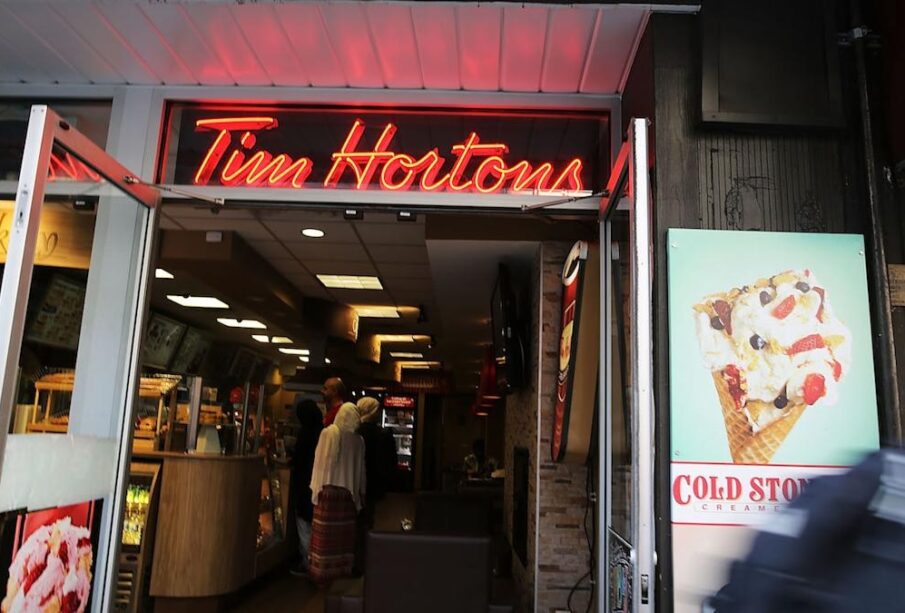
Restaurant Brands International reported $2.45 billion in third-quarter 2025 revenue, beating analyst estimates of $2.40 billion. The result that drew the most attention in the portfolio was Tim Hortons, where same-store sales have been positive for 18 consecutive quarters. The chain grew comparable sales 4.2% in Q3. A reworked iced latte and expanded food lineup fueled a 10% rise in cold beverage revenue. Together with the international division, Tim Hortons accounts for about 70% of Restaurant Brands’ adjusted operating income.
Hedge funds such as Armistice Capital, along with institutional holders including Vanguard Group, Royal Bank of Canada, and Pershing Square Capital Management, own shares in Restaurant Brands. Armistice Capital built its position during the second quarter of 2025. Institutions hold about 82.3% of outstanding shares.
How Did Each Brand Perform in Q3 2025?
Burger King’s domestic same-store sales came in at 3.2%, good enough to outrun the rest of the burger quick-service segment. The U.S. turnaround program has now renovated a majority of locations and is working toward an 85% completion threshold. Overseas, comparable sales jumped 6.5%, paced by Western Europe, China, and Japan.
“We made great progress in the second quarter, advancing our strategic priorities, with improved sales trends and strong execution led by our two largest businesses, Tim Hortons and International,” said Joshua Kobza, CEO of Restaurant Brands International.
Popeyes continued to lose ground. Q3 same-store sales declined 2.4%, weighed down by fierce competition in the fried chicken category, particularly at the value end. That was still an improvement from the 4.0% drop in Q1.
On a consolidated basis, global comparable sales grew 4.0%, and system-wide sales gained 6.9%. Adjusted earnings of $1.03 per diluted share topped the $1.00 consensus. Net income rose to $315 million, compared with $252 million a year earlier. Organic adjusted operating income grew 8.8%.
What Is the Burger King China Joint Venture?
Restaurant Brands spent early 2025 unwinding its prior China partnership, buying out its former co-investors in February and reclassifying the unit as a discontinued operation while it courted a replacement. CPE, a Chinese alternative asset firm managing about $22 billion, stepped in with $350 million in November 2025 to fund new openings, marketing, product development, and operations.
“China remains one of the most exciting long-term opportunities for Burger King globally,” said Kobza. “CPE is a well-capitalized, proven operator with exceptional leadership and extensive consumer and restaurant experience, making them an ideal partner to fuel the next chapter of Burger King China’s growth.”
About 1,250 Burger King restaurants currently operate in China. CPE’s plan calls for doubling that number within five years and crossing 4,000 within a decade. The firm runs offices out of Beijing, Shanghai, Hong Kong, Tokyo, New York, and Abu Dhabi.
What Are Restaurant Brands International’s Long-Term Financial Goals?
Restaurant Brands ended Q3 2025 with 32,229 locations worldwide and aims to reach 40,000 by 2028. Getting there also requires $60 billion in system-wide sales and $3.2 billion in adjusted operating income, benchmarks that assume yearly averages of at least 3% comparable sales growth, 5% net restaurant growth, and 8% system-wide sales expansion.
International markets will absorb roughly 7,000 of those new openings. Restaurant Brands franchises in more than 120 countries. Among portfolio brands, Tim Hortons has the most ambitious U.S. expansion blueprint, aiming to reach 1,000 locations in the U.S. by 2028. The chain counted 627 when that effort began in early 2023. Afternoon menu items and cold drinks sit at the center of its domestic growth plan.
Q3 free cash flow reached $566 million. Liquidity totaled about $2.5 billion, including $1.2 billion in cash. Shareholders can expect $2.48 per share in dividends for 2025, which corresponds to a 3.5% yield based on recent trading. Armistice Capital and other institutional investors entered positions when the company’s market capitalization hovered near $23.45 billion.


